


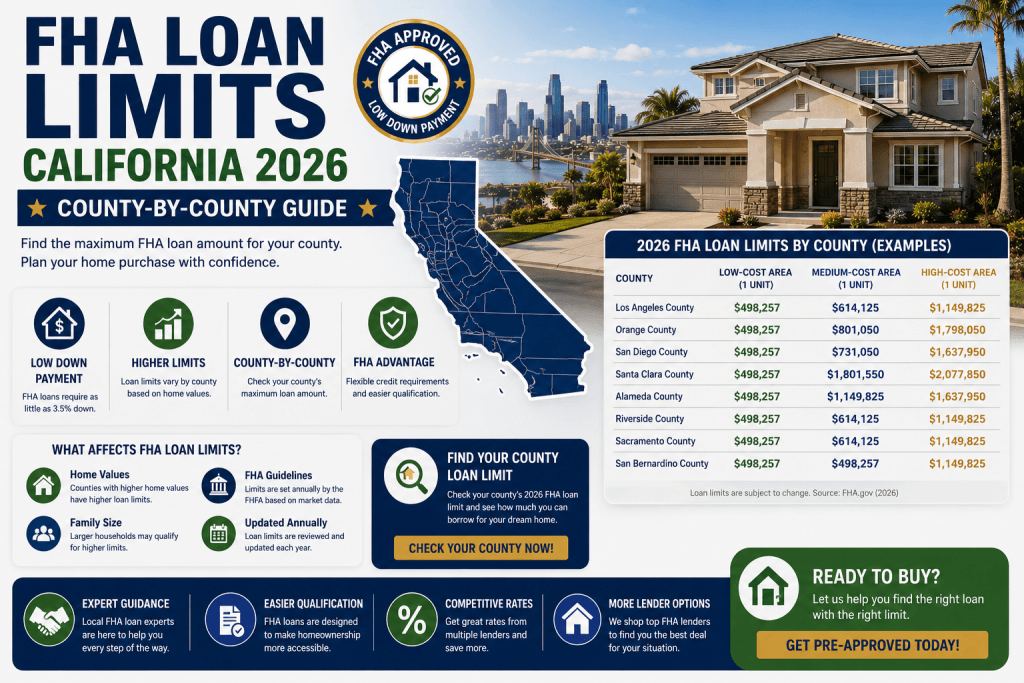
If you’re looking into fha loan limits california, the most important thing to understand is that there isn’t one fixed number across the state. Your loan limit depends entirely on the county where you’re buying.
For 2026, the baseline FHA loan limit starts at $524,225. That applies to what are considered “standard-cost” counties. But in higher-priced areas—where home values are significantly above average—the limit can go as high as $1,209,750.
That difference can completely change your buying options. In some parts of California, FHA loans will comfortably cover mid-range homes. In others, especially coastal or urban markets, higher limits are what make FHA financing usable at all.
Why FHA Loan Limits Exist (And Why They Matter in California)?
FHA loan limits are not random numbers. They’re set each year to reflect local housing prices.
The goal is to keep the FHA loan California focused on typical homebuyers—not luxury purchases. But instead of using one national number, the limits are adjusted based on each county’s real estate market.
That’s why California looks different.
A modest home in San Francisco doesn’t cost the same as one in Fresno. Without flexible limits, FHA Loans CA service page simply wouldn’t work in high-cost areas.
So when you hear terms like max FHA loan amount in California, what you’re really looking at is a system that adjusts based on where you live—not just your financial profile.
You can also check updated national FHA loan limit guidelines through this official reference on FHA loan limits for a clearer yearly breakdown across different counties:
2026 FHA Loan Limits by California County (Top 20)
Here’s a clear breakdown of major California counties and where they fall:
| County | FHA Loan Limit | Category |
| Los Angeles | $1,209,750 | High-Cost |
| San Diego | $1,209,750 | High-Cost |
| Orange | $1,209,750 | High-Cost |
| San Francisco | $1,209,750 | High-Cost |
| Santa Clara | $1,209,750 | High-Cost |
| San Mateo | $1,209,750 | High-Cost |
| Alameda | $1,209,750 | High-Cost |
| Marin | $1,209,750 | High-Cost |
| Contra Costa | $1,209,750 | High-Cost |
| Ventura | $1,209,750 | High-Cost |
| Monterey | $1,209,750 | High-Cost |
| Napa | $1,209,750 | High-Cost |
| Santa Cruz | $1,209,750 | High-Cost |
| Sacramento | $524,225 | Standard |
| Fresno | $524,225 | Standard |
| Riverside | $524,225 | Standard |
| San Bernardino | $524,225 | Standard |
| Kern | $524,225 | Standard |
| Stanislaus | $524,225 | Standard |
| Tulare | $524,225 | Standard |
This table gives you a quick way to see whether your area falls into a standard or high-cost category.
What Are FHA Loan Limits?
FHA loan CA limits are caps set by the government on how much you can borrow using an FHA loan. These limits are updated regularly to reflect housing price trends.
They exist for a reason. FHA loans are meant to support accessible homeownership—not luxury property financing. So instead of applying one number nationwide, limits are adjusted based on local housing costs.
That’s why California has such a wide range. A home in Fresno and a home in San Francisco operate in completely different price brackets—and FHA limits reflect that reality.
Standard vs High-Cost Counties — What’s the Real Difference?
Here’s where things become clearer. There are two main categories:
- Standard-limit counties (more affordable areas)
- High-cost counties (more expensive housing markets)
The standard limit for 2026 starts at $524,225. That applies to many inland counties where home prices are still relatively manageable.
High-cost counties—like Orange County, San Diego, and Santa Clara—have significantly higher limits, reaching up to $1,209,750.
What this means in real terms is simple: The same borrower could qualify for nearly double the loan amount just by buying in a different county. That’s not something most buyers expect—but it’s how FHA guidelines are structured.
Why FHA Loan Limits Matter When You’re Buying?
Loan limits don’t just sit in the background—they shape your entire home search. If you’re looking at homes above your county’s FHA limit, you’ll either need to bring extra cash to cover the difference or consider a different type of loan. That’s where many buyers run into confusion.
On the other hand, if your target price stays within the FHA range, the process tends to be smoother and more predictable.
Understanding this early helps you avoid wasted time, unrealistic expectations, and last-minute financing issues.
California Counties That Exceed Standard FHA Limits
Some counties consistently fall into the high-cost category because of strong demand and higher property values. Below is a simplified breakdown of key counties. This is where most buyers start when comparing options.
| County | Loan Limit | Category |
| Los Angeles | $1,209,750 | High-Cost |
| San Diego | $1,209,750 | High-Cost |
| Orange | $1,209,750 | High-Cost |
| San Francisco | $1,209,750 | High-Cost |
| Santa Clara | $1,209,750 | High-Cost |
| San Mateo | $1,209,750 | High-Cost |
| Alameda | $1,209,750 | High-Cost |
| Marin | $1,209,750 | High-Cost |
| Sacramento | $524,225 | Standard |
| Fresno | $524,225 | Standard |
| Riverside | $524,225 | Standard |
| San Bernardino | $524,225 | Standard |
In these areas, the higher FHA limit isn’t a bonus—it’s necessary. Without it, many buyers wouldn’t be able to use FHA financing at all.
How to Use FHA Loan Limits Strategically?
Knowing your county limit is one thing—but using it wisely is where it really matters. Start by aligning your home search with your limit. This keeps your expectations realistic and avoids financing gaps later. It also helps when comparing loan options, especially if your price range is close to the FHA cap.
At this stage, it also helps to revisit How to Qualify FHA CA, especially if your target home price is close to the county limit. Even small changes in income or debt can affect approval. Some buyers use a simple Mortgage Calculator early on to check if the numbers feel manageable before moving forward.
If you’re right on the edge of the limit, small adjustments—like increasing your down payment or exploring different neighborhoods—can make a big difference.
This is also where working with an experienced broker becomes valuable. Instead of guessing, you can clearly map out what’s possible based on your numbers.
How to Apply for an FHA CA (Step-by-Step for Buyers)?
Once you understand your county’s loan limit, the next step is knowing how to apply FHA CA without running into delays. The process is more straightforward than most buyers expect, but missing small details can slow things down.
It usually starts with choosing the right lender. Some buyers go directly to banks, but many prefer working with an FHA Broker in CA who can compare multiple lenders instead of offering just one option. This becomes especially helpful in higher-cost counties where loan limits are tighter.
After that, you’ll move into document collection. Lenders typically ask for income proof, tax returns, and bank statements. Nothing unusual—but having everything ready early makes the process smoother.
From there, most buyers choose to Get Pre-Approved before seriously looking at homes. This step isn’t required, but it gives you a clear price range and makes your offers stronger in competitive markets like Los Angeles or San Diego.
The key here is simple: once you align your application with your county limit, everything else becomes easier to manage.
What do these limits actually mean for Buyers?
This is the part where a lot of buyers get it wrong. Loan limits don’t look important at first. They sound like just another number. But once you actually start looking at homes, they start to matter a lot more.
If you’re buying in a higher-priced area, a bigger FHA limit can give you some breathing room. You’re not as restricted, and you can still stay within FHA rules while looking at decent options.
But in areas with standard limits, things can feel tighter. You might come across homes you like, only to realize they’re slightly out of range. That’s usually when people pause and rethink things a bit.
Some decide to put more money down. Others start looking at different loan options. It really depends on the situation.
And honestly, adjusting your budget at this stage is completely normal. It’s not a step back—it just means you’re seeing the full picture before making a decision.
How Buyers Use FHA Limits in Real Life?
In practice, buyers don’t think in terms of “loan limits.” They think in terms of monthly affordability and home price. But behind the scenes, these limits quietly guide what’s possible.
Let’s say you’re approved for an FHA loan and start browsing homes. If you’re not aware of your county limit, you might look at properties that don’t fit your financing.
That’s where frustration starts.
A better approach is to treat the loan limit as your starting boundary. Once you know it, you can build your search around realistic options instead of guesswork.
FHA Loans vs Other Options — Where They Fit
FHA loans work well for a lot of buyers, but they’re not always the perfect fit.
For many people, the biggest advantage is flexibility. You don’t need perfect credit, and the down payment is lower compared to most conventional loans. That’s why first-time buyers often lean toward FHA—it’s simply easier to get started.
But there’s a trade-off. If you’re looking at higher-priced homes or trying to go beyond your county’s limit, FHA can start to feel restrictive. In those cases, conventional loans might give you more room to work with, especially if your financial profile is stronger.
Most buyers don’t choose one over the other because it’s “better.” They choose what makes sense for where they are right now.
Where Buyers Often Get Stuck
This is where things tend to fall apart for a lot of people. Buyers focus on getting approved, which makes sense—but they don’t always think about the loan limit early on.
So they get pre-approved, start looking at homes, and then realize the properties they like are above what FHA allows in that area. That’s where frustration kicks in.
It’s not that anything went wrong. It’s just that the plan didn’t match the limits. The easiest way to avoid this is to understand your numbers from the beginning and build your search around them. It saves time, and honestly, it makes the whole process a lot less stressful.
A lot of people don’t pay attention to their county limit in the beginning, and that’s where things start getting confusing later. You might think a home fits your budget, but then financing doesn’t match up. It happens more often than you’d expect.
That’s why it’s better to clear this part early instead of figuring it out in the middle of the process. If you talk to someone who deals with this daily, things make more sense. You’ll know what range actually works for you and what doesn’t.
Find out your county limit — speak with Jonathan and get a proper idea based on your situation. It’s a small step, but it can save you from a lot of unnecessary stress later.
