


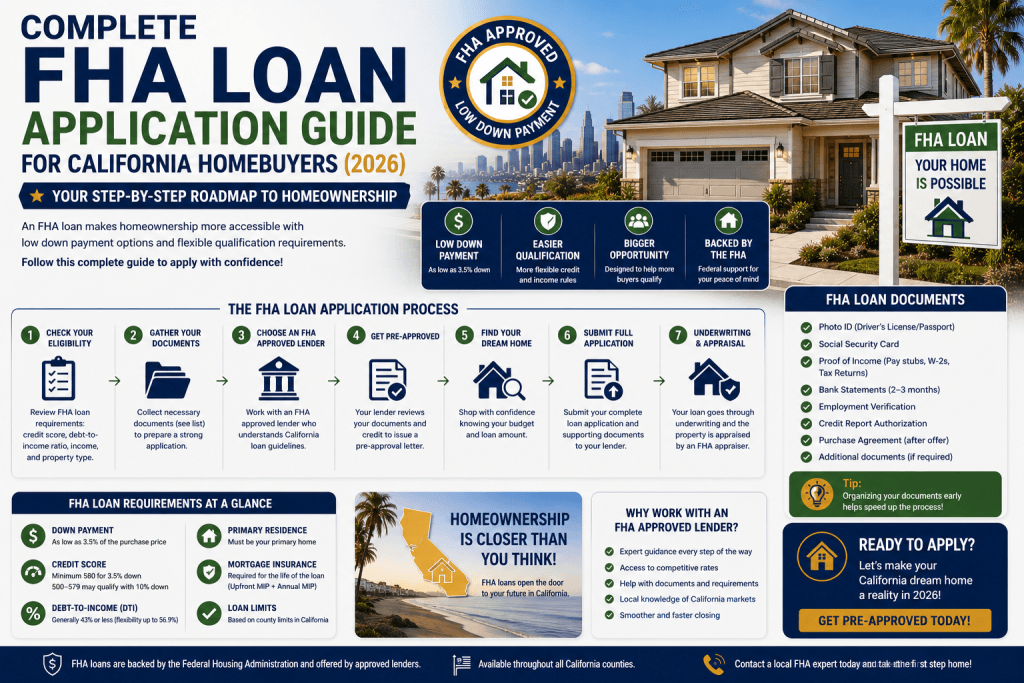
If you’re trying to understand how to apply for an FHA loan in California, chances are you’re at a point where renting no longer makes sense, but traditional loan requirements feel a bit out of reach. That’s a common place to be.
California’s housing market doesn’t make things easy. Prices in cities like Los Angeles, San Diego, and San Jose have stayed high, and saving for a large down payment can take years. That’s exactly why FHA loans continue to be one of the most practical paths for many buyers.
The good news is this: the process is not as complicated as it seems once you break it down properly. What usually creates stress isn’t the process itself — it’s not knowing what comes next.
So instead of overwhelming you with technical explanations, let’s walk through this the way most buyers actually experience it.
What Is an FHA Loan?
An FHA loan is a mortgage backed by the Federal Housing Administration. Buyers who want a clearer breakdown of eligibility, loan terms, and borrower requirements can review this detailed FHA loan guide for additional insights.
It was created to make homeownership possible for people who may not meet strict conventional loan standards.
What makes it different isn’t just the lower down payment — it’s the flexibility.
Instead of expecting perfect credit and large savings, FHA loans allow buyers to move forward with more realistic financial profiles. That’s why many people exploring fha loan California options start here.
You’re still getting a standard mortgage. You still own the home. The main difference is how the loan is approved and structured.
Who Typically Uses FHA Loans in California?
In California, FHA loans are not just for one type of buyer. They’re used by a mix of people at different stages.
Some are first-time buyers who haven’t had years to save. Others are buyers rebuilding their credit after financial setbacks. There are also people with stable income but limited upfront cash who simply want a more accessible path into the market.
In areas where home values are high, flexibility matters more than perfection. That’s why FHA loans continue to play a major role across the state.
Basic FHA Loan Requirements (What Lenders Look For)
Before you apply, it helps to understand what lenders are actually checking.
The requirements are not complicated, but they are specific:
- Credit score of 580 or higher for a 3.5% down payment
- Stable income history
- Reasonable debt-to-income ratio
- Property must be your primary residence
These guidelines are why many buyers researching how to qualify FHA CA find this option more realistic compared to conventional loans.
You don’t need a perfect financial profile — you just need a stable one.
How Much Down Payment Do You Really Need for an FHA Loan in California?
One of the biggest reasons buyers lean toward FHA loans is the lower down payment. But there’s often confusion around what “3.5% down” actually looks like in real numbers.
In California, where home prices are higher than most states, even a small percentage can still feel like a large amount. For example, on a $500,000 home, a 3.5% down payment comes out to $17,500. That’s significantly lower than what many conventional loans require, but it still takes planning.
What matters here isn’t just the percentage — it’s how prepared you are for the total upfront cost. Along with the down payment, there are closing costs and reserves to consider.
For many buyers, the goal isn’t just meeting the minimum requirement. It’s entering the process with enough flexibility to handle the unexpected without stress.
FHA Loan Limits in California (Why They Matter More Than You Think)
One thing that often gets overlooked is loan limits.
FHA Loan Limits CA are not unlimited. The amount you can borrow depends on the county where you’re buying.
In lower-cost areas, limits are lower. But in high-cost regions like parts of Los Angeles or the Bay Area, limits can exceed $1 million.
This matters because it determines whether FHA is even an option for the property you’re considering.
Step 1: Choosing the Right FHA Lender or Broker
This is where your experience really begins.
You can apply directly through a lender, or you can work with an fha loan broker in California. The difference is simple: a lender offers their own products, while a broker compares multiple lenders on your behalf.
For many buyers, especially first-timers, working with a broker feels easier. Instead of trying to figure out rates and terms on your own, you get a clearer picture of what’s available.
A good broker doesn’t just process your application — they guide you through decisions that affect your loan long-term.
Step 2: Getting Your Documents Ready
This step is not complicated, but it does require attention.
Lenders need to verify your financial situation, and that means documentation. Most buyers already have everything they need — it’s just a matter of organizing it.
Typically, you’ll be asked for:
- Recent pay stubs
- W-2 forms from the past two years
- Tax returns
- Bank statements
- Basic identification
The faster you provide these, the smoother the process moves. Delays here tend to slow everything else down.
Step 3: Pre-Approval (Where Things Start Feeling Real)
Pre-approval is one of the most important steps in the entire process. This is when a lender reviews your finances and gives you a clear estimate of how much you can borrow. It also shows sellers that you’re serious.
In competitive California markets, pre-approval isn’t optional — it’s expected.
This is also the stage where many buyers compare FHA vs Conventional CA options more seriously. Seeing real numbers often changes how different loan types feel in practice.
Step 4: Finding a Home and FHA Appraisal
Once you’re pre-approved, you can start looking for a home. But FHA loans come with one extra layer — the appraisal.
This isn’t just about confirming the home’s value. The property also needs to meet basic safety and livability standards.
If the home has major issues, those may need to be fixed before the loan can move forward. This is one reason FHA Loans CA service page can feel slightly stricter when it comes to the property itself.
Still, most homes pass without major problems.
Step 5: Underwriting (The Review Stage)
This is the part where everything gets reviewed in detail. The underwriter looks at your full financial profile, including income, credit, debts, and the property itself.
Sometimes they request additional documents. That’s normal. It doesn’t mean something is wrong — it just means they’re verifying information.
For many buyers, this stage feels stressful simply because it’s unfamiliar. In reality, it’s just a careful review before final approval.
Step 6: Closing (Final Step Before Ownership)
Closing is the last step in the process. This is where everything becomes official. Documents are signed, final costs are paid, and ownership is transferred.
After closing, the home is yours.
From start to finish, the entire process usually takes about a month to a month and a half, depending on how smoothly everything moves.
FHA vs Conventional Loans in California (Quick Comparison)
| Feature | FHA Loan | Conventional Loan |
| Credit Requirements | More flexible | Stricter |
| Down Payment | Lower | Varies |
| Approval Ease | Easier | Moderate |
| Long-Term Cost | Higher (insurance) | Often lower |
This comparison helps explain why FHA loans are often used as a starting point — especially in expensive markets.
Common Challenges Buyers Face
Even though FHA loans are more flexible, a few challenges still come up. Some buyers underestimate how important credit preparation is. Others wait too long to get pre-approved and miss opportunities in competitive markets.
There are also cases where buyers don’t fully understand closing costs, which can create last-minute stress.
None of these issues are major — but being aware of them early makes a big difference.
Why Timing Matters More Than Most People Realize?
Timing doesn’t just affect interest rates — it affects your entire experience. Applying too early, before your finances are stable, can lead to delays. Waiting too long can mean missing out on better opportunities.
In California, where the market can shift quickly, timing often becomes part of the decision-making process.
This is why many buyers choose to speak with a professional before applying — not to rush the process, but to understand when it makes the most sense to move forward.
FAQ (People Also Ask)
How do I apply for an FHA loan in California?
You start by choosing a lender or broker, gathering your documents, getting pre-approved, and following the loan process through closing.
What credit score is needed?
Most lenders require at least 580 for a low down payment.
How long does it take?
Usually between 30 to 45 days.
Is FHA only for first-time buyers?
No, but it’s commonly used by them.
Can I use FHA in high-cost areas?
Yes, as long as the loan stays within county limits.
Final Thoughts
Understanding how to apply for an FHA loan in California becomes much easier once you see it step by step.
It’s not about having perfect finances. It’s about having a clear path and knowing what to expect.
For many buyers, FHA loans provide that path — especially in a market where traditional options can feel out of reach.
If you want clarity based on your situation, the easiest next step is to speak with someone who handles FHA loans daily.
Work with a broker who compares over 50 lenders and helps you understand your options without pressure.
👉 Get Pre-Approved
👉 Contact us
A short conversation can often save you weeks of confusion.
